Welcome

  • Disability Day Disability Day
  • GA Capitol GA Capitol
  • AdaPrade AdaPrade
  • Bingo Bingo
  • hoola hoop hoola hoop
  • Limbo Limbo
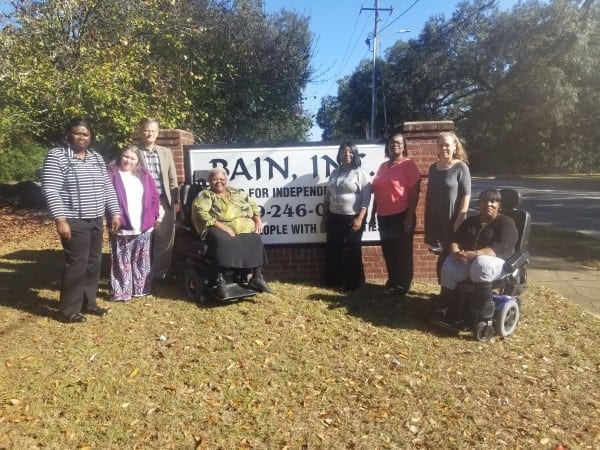
  • BAIN Staff and Board BAIN Staff and Board
  • Gov. Deal Gov. Deal
  • Disability Day 4 Disability Day 4
  • BAIN ramp BAIN ramp
  • 2 grab bars hand held shower rollin shower 2 grab bars hand held shower rollin shower
  • grab bars grab bars
  • Assessable Sink Assessable Sink

Bainbridge Advocacy Individual Network, Inc (BAIN) is a consumer driven, non-residential Center for Independent Living (CIL) serving eleven counties throughout Southwest Georgia. BAIN is a non-profit, community based resource and advocacy center run by and for individuals with disabilities. We reach even the most rural areas to provide information and referrals, peer support,independent living skills training and advocacy services that ultimately give others the tools to pursue freedom from dependence. It is our philosophy that people with disabilities can control and direct their own lives, taking risks and either failing or succeeding on their own terms.

Counties We Serve:

BAIN Center for Independent Living serves people with disabilities of all ages in the GA counties of Baker, Calhoun, Clay, Decatur, Early, Grady, Miller, Mitchell, Randolph, Seminole, and Thomas.

Our Funding Sources:

BAIN is funded through Public & Private Donations, U.S. Department of Education, Foundations, United Way, Local Government, and the Georgia Department of Labor.

Hours of Operation:

Monday – Thursday 8 a.m. to 6:30 p.m

BAIN will be closed during the Thanksgiving Holidays: Nov. 22, Nov. 23 & Nov. 26.

Let Us Help You:

Find out about our many Programs

News You Should Know:

 BAIN Hosting Town Hall Meeting with Tools For Life


Learn More about Maintaining Your Chair, Ramps and other Durable Medical Equipment


When: Wednesday, November 28, 2012

Time: 2:00 pm – 4:00 pm

Where: Gilbert H. Gregg Library in Bainbridge, GA

Do you have questions about how to care for your wheelchair, medical equipment and your ramp? Need information on funding resources? Learn about the Do’s & Don’ts and general tips on service and maintaining your equipment.

Join BAIN, Inc. and other leading medical professionals to learn safety tips and much more that will help you lead a more independent life.

Refreshments will be served.

If you would like to participate, call BAIN’s Home Access Coordinator Hubert Thomas at 246-0150 by Tuesday, November 27, 2012 to RSVP.

Transportation will be provided.


ALERT:  BAIN has received 5 boxes of “Advocate” 30G 100 pack lancets, 5 boxes of “Advocate” redi-code 50 count test strips and a bag of 25+ lancets for use with “Advocate” brand blood sugar testing devices. If you or someone you know could use these items, please contact Shaye at 246-0150 and pick them up from BAIN’s office.


November Observances

American Diabetes Month; for more information CLICK HERE

COPD Awareness Month; for more information CLICK HERE

Lung Cancer Awareness Month; for more information CLICK HERE

National Stomach Cancer Awareness Month; for more information CLICK HERE

Alzheimer’s Disease Awareness Month; for more information CLICK HERE

National Family Caregivers Month; for more information CLICK HERE

Epilepsy Awareness Month; for more information CLICK HERE

Winter Weather Preparedness for People with Disabilities

Now is the time to prepare for winter weather. People with disabilities may need to take additional precautions in order to be ready for expected and unexpected winter weather events.  First, get a kit.  Make sure your kit includes warm clothing, blankets, food, water, a flashlight, and small shovel, salt or sand, and additional blankets and supplies for service animals and pets.  Try to obtain an emergency supply of medications and medical supplies in case travel becomes hazardous.   Remember that cold weather can stress respiratory and circulatory systems, making it more difficult to travel or complete tasks that require physical exertion.   Additional winter weather tips for people with disabilities:

NDAD Blog – Winter Weather and People with Disabilities: http://ndad.areavoices.com/2012/10/04/winter-weather-checklist-provides-planning-guide-for-people-with-disabilities-health-challenges/

Ready.gov Winter Stores and Extreme Cold Preparedness Tips: http://www.ready.gov/winter-weather

Centers for Disease control and prevention: Extreme Cold: A Prevention Guide to Promote your Personal Health and Safety: http://www.bt.cdc.gov/disasters/winter/guide.asp


Who are People with Disabilities?

People with disabilities are — first and foremost, people — people who have individual abilities, interests and needs. For the most part, they are ordinary individuals seeking to live ordinary lives. People with disabilities are moms, dads, sons, daughters, sisters, brothers, friends, neighbors, coworkers, students and teachers.  About 54 million Americans — one out of every five individuals — have a disability. Their contributions enrich our communities and society as they live, work and share their lives.

Changing Images Presented

Historically, people with disabilities have been regarded as individuals to be pitied, feared or ignored. They have been portrayed as helpless victims, repulsive adversaries, heroic individuals overcoming tragedy, and charity cases who must depend on others for their well being and care. Media coverage frequently focused on heartwarming features and inspirational stories that reinforced stereotypes, patronized and underestimated individuals’ capabilities.

Much has changed lately. New laws, disability activism and expanded coverage of disability issues have altered public awareness and knowledge, eliminating the worst stereotypes and misrepresentations. Still, old attitudes, experiences and stereotypes die hard.

People with disabilities continue to seek accurate portrayals that present a respectful, positive view of individuals as active participants of society, in regular social, work and home environments. Additionally, people with disabilities are focusing attention on tough issues that affect quality of life, such as accessible transportation, housing, affordable health care, employment opportunities and discrimination.

Eliminating Stereotypes — Words Matter!

Every individual regardless of sex, age, race or ability deserves to be treated with dignity and respect. As part of the effort to end discrimination and segregation — in employment, education and our communities at large — it’s important to eliminate prejudicial language.

Like other minorities, the disability community has developed preferred terminology — People First Language. More than a fad or political correctness, People First Language is an objective way of acknowledging, communicating and reporting on disabilities. It eliminates generalizations, assumptions and stereotypes by focusing on the person rather than the disability.

As the term implies, People First Language refers to the individual first and the disability second. It’s the difference in saying the autistic and a child with autism. (See the following.) While some people may not use preferred terminology, it’s important you don’t repeat negative terms that stereotype, devalue or discriminate, just as you’d avoid racial slurs and say women instead of gals.

Equally important, ask yourself if the disability is even relevant and needs to be mentioned when referring to individuals, in the same way racial identification is being eliminated from news stories when it is not significant.

What Should You Say?

Be sensitive when choosing the words you use. Here are a few guidelines on appropriate language.

  • Recognize that people with disabilities are ordinary people with common goals for a home, a job and a family. Talk about people in ordinary terms.
  • Never equate a person with a disability — such as referring to someone as retarded, an epileptic or quadriplegic. These labels are simply medical diagnosis. Use People First Language to tell what a person HAS, not what a person IS.
  • Emphasize abilities not limitations. For example, say a man walks with crutches, not he is crippled.
  • Avoid negative words that imply tragedy, such as afflicted with, suffers, victim, prisoner and unfortunate.
  • Recognize that a disability is not a challenge to be overcome, and don’t say people succeed in spite of a disability. Ordinary things and accomplishments do not become extraordinary just because they are done by a person with a disability. What is extraordinary are the lengths people with disabilities have to go through and the barriers they have to overcome to do the most ordinary things.
  • Use handicap to refer to a barrier created by people or the environment. Use disability to indicate a functional limitation that interferes with a person’s mental, physical or sensory abilities, such as walking, talking, hearing and learning. For example, people with disabilities who use wheelchairs are handicapped by stairs.
  • Do not refer to a person as bound to or confined to a wheelchair. Wheelchairs are liberating to people with disabilities because they provide mobility.
  • Do not use special to mean segregated, such as separate schools or buses for people with disabilities, or to suggest a disability itself makes someone special.
  • Avoid cute euphemisms such as physically challenged, inconvenienced and differently abled.
  • Promote understanding, respect, dignity and positive outlooks.

“The difference between the right word and the almost right word is the difference between lightning and the lightning bug.”  Mark Twain

Examples of People First Language

Say This Not This
people with disabilities the handicapped, the disabled
people without disabilities normal, healthy, whole or typical people
person who has a congenital disability person with a birth defect
person who has (or has been diagnosed with)… person afflicted with, suffers from, a victim of…
person who has Down syndrome Downs person, mongoloid, mongol
person who has (or has been diagnosed with) autism the autistic
person with quadriplegia, person with paraplegia, person diagnosed with a physical disability a quadriplegic, a paraplegic
person with a physical disability a cripple
person of short stature, little person a dwarf, a midget
person who is unable to speak, person who uses a communication device dumb, mute
people who are blind, person who is visually
impaired
the blind
person with a learning disability learning disabled
person diagnosed with a mental health condition crazy, insane, psycho, mentally ill, emotionally disturbed, demented
person diagnosed with a cognitive disability or with an intellectual and developmental disability mentally retarded, retarded, slow, idiot, moron
student who receives special education services special ed student, special education student
person who uses a wheelchair or a mobility chair confined to a wheelchair; wheelchair bound
accessible parking, bathrooms, etc. handicapped parking, bathrooms, etc.


Share